I Bought the $300 Shoes I Swore I Didn't Need.
Here's what happened.
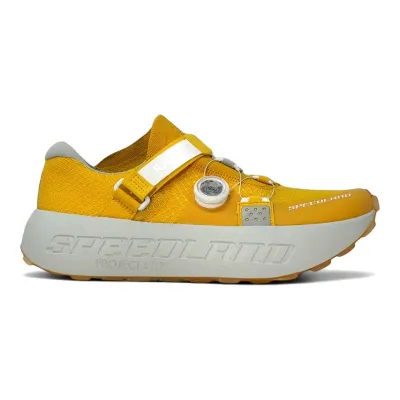
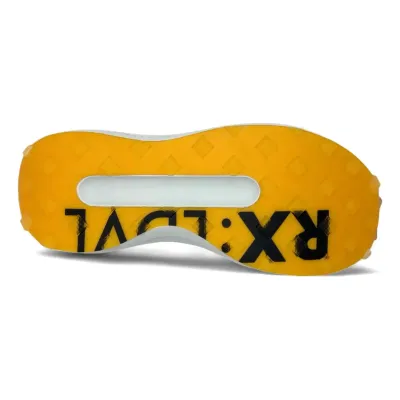
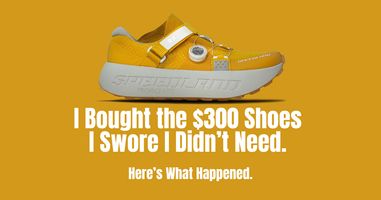
“You should get them!” my co-worker at Salida Mountain Sports (“SMS”) urges me as I float around the store in a pair of Speedland RX:LDVL trail runners. They are banana yellow with white accents and a white couch cushion of a sole. Speedland also tossed laces in favor of a boa and a velcro. They are the most comfortable things I have ever put on my feet. Period. Full stop. But these are serious technical shoes for long distance trail and ultra runners - complete with removable carbon inserts to help with “energy rebound” whatever that means - and at a whopping $300 I felt silly for even trying them on. As you may have gathered, I am not a long distance or ultra runner. In fact, I am barely a runner at all, and would not classify myself as a “real” runner.
Before I continue I will give you some relevant information about me: I am a full on dirtbag and get almost all my exercise in the mountains: hiking, skiing, ski touring, mountain and gravel biking and, until recently, occasionally running. I broke my tibia and fibula and ripped some ligaments in my ankle in December of 2025 in a bike crash, requiring a fairly big surgery and a lot of new metal bling I now wear on the inside of my leg, underneath a badass scar I accented
with a tattoo, because of course I did.
I began dabbling in running in 2005 my first year of law school. I ran three to five miles a day through the streets of Cleveland Ohio, primarily to lose weight, stay fit and stay sane during law school in, you know, Cleveland. I never thought of running as anything more than a means to an end and I can’t say I actually enjoyed it. Despite being an athlete my whole life - soccer goalie, basketball, lacrosse (college and semi-pro post collegiate) and tennis, running al a carte had always been challenging to me both physically and mentally. When I moved to Colorado years later and discovered trail running is way more enjoyable than pounding the pavement or a treadmill, I maxxed out running perhaps three to nine miles (longest), once a week, because it still always hurt like hell. My bad knees, my bad ankle, my feet: screaming by mile three or four. It never occurred to me that someone so novice and lowkey - I identify as slowkey - needed any running shoe other than one that worked and at least mostly fit.
In the months of PT after surgery to repair my leg and ankle, running was the last thing I was
cleared to do. My PT asked me what shoes I was in and when I told her she said “absolutely
not. Those are zero drop, you need something with way more support and cushioning and
something that fits correctly.” Well…s**t. Also, umm, what?
When I started at SMS - the owners and most of my colleagues are avid trail/distance runners and our resident running guru was about to run the High Lonesome 100 - I learned that the “drop” of a running shoe refers to the difference between the height of the toe and the height of the heel (in mm). I’ll spare you too much shop talk, suffice to say a zero drop shoe engages calf muscles quite a bit more and works well for those who have proper running technique. After breaking my tibia and fibula and shredding a couple of ligaments in my ankle my calf muscles were atrophied and it would take a lot of work to get them to a point where they could
adequately support my metal-cased bones and threaded joint. High drop shoes reduce stress on the calves and also are good for heel strikers which I undoubtedly am. I also learned the “stack height” of a running shoe tells you how much cushion there is for the pushin’, which I needed a lot of. The Leadvilles I was lustfully bopping around the shop in on a daily basis boast a 7mm drop and up to 42 mm of stack. They are clouds spliced with tires.
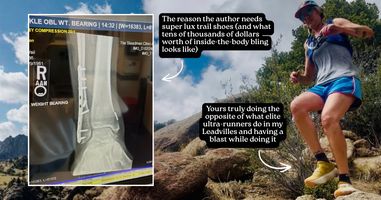
"I didn’t buy them initially because I was wary of how dumb I would look hobble-jogging three seventeen minute miles or something on S mountain.."
amidst all the real runners who say things like “I only did 13 miles yesterday” or “why yes, I am choosing to try to run 100 miles without bionic limbs or hard steroids” on the regs. I felt like I’d be a poser. A wannabe. Like that guy who drives the fastest BMW in the right lane of I-70 and you think “I mean did you really need that car for this, guy?” Did I really need those shoes for this? Mostly, I didn’t want anyone who saw me running in the Ferrari of trail shoes to think I thought I was badass enough to need them. The bright banana yellow (which I adore) also doesn’t not scream “everyone come see how good I look” and attention on me while yogging and sucking wind while in V-Tach is something I strive to avoid.
Long story short: I got them anyway. I noticed an instant difference in how my ankle felt
throughout the day just standing and walking around in them and the first “real” trail run I
attempted - four and a half miles on singletrack in Buena Vista with about five hundred vert - I noticed how much less pain I felt in not only my ankle, but in my trashed ski bum knees. Although running is still really tough for me, it is a hell of a lot more fun when the gear you have takes all but the most inherent unpleasantnesses out of the endeavor. When stuff is more fun, we want to do more of it which usually means we’ll get better at it and also, in the case of trail
running, reap more and more fitness and health benefits, mentally and physically.
This brings me to my point: we don’t need to be pro athletes or even experts to get the best
nicest, lightest high performance gear. You are not a poser or a wannabe if you drop a ton of
money on something that lights you up, keeps you in shape and might be a pursuit you can get more and more into as long as it is fun and not horribly painful all the time. Upper echelon gear and apparel, especially with running, biking and skiing, helps a lot with this by helping us be more efficient, more pain free, and not having to worry about things breaking, malfunctioning or making the activity harder, as with the wrong shoe causing blisters or joint pain, skis that are
too heavy or soft, a pack or a vest that rubs or bruises, etc. If the best gear for you as a
beginner or an intermediate is the nicest and most techy and you can afford it, send it. I am
giving you permission.
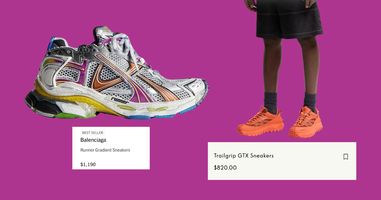
Lastly, just for funsies, another added bonus of the souped up trail shoe: fashion! You read that correctly. It is on trend these days to wear giant, lifted running shoes the same way Carrie Bradshaw used to rock Manolos in the early aughts. Montcler and Balenciaga are just two of the many houses offering insanely expensive trail runners (pictured below) to celebrities and fashion whores around the world, and they’re selling like hot cakes. I cannot wait to pair my comparatively cheap Leadvilles with some cool denim or a chic skirt the next time I return to New York City. Win-win!